


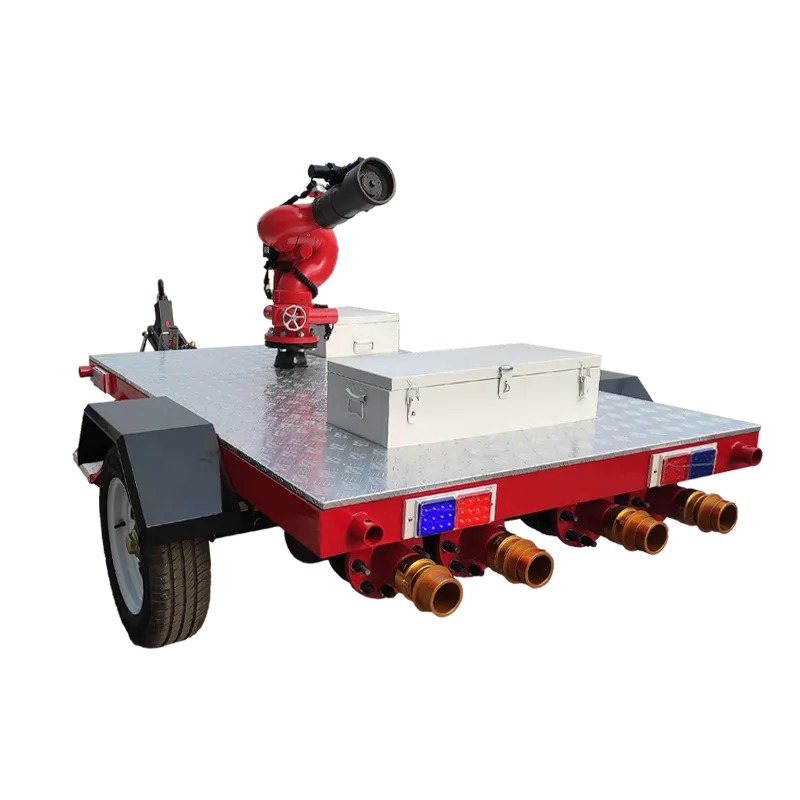
Trailer-mounted electrically controlled fire monitor (150 L/s) PSKDY10/150 · PLKDY10/150
Product Overview
- The trailer-mounted, electrically controlled fire monitor is a mobile, remotely operated firefighting unit consisting of an electrically controlled fire monitor integrated onto a trailer chassis (or a wheeled carriage). It features a rated flow rate of 150 L/s and comprises a wireless remote controller, a wired control handle, an electrical control box, an electric rotation and elevation mechanism, and a trailer chassis. Designed for use in areas such as petrochemical tank farms, oil terminals, oil depots, and large storage yards, this mobile, remotely operated system can be rapidly relocated and deployed. It allows operators to conduct firefighting operations from a safe distance, effectively ensuring their personal safety.
- This product complies with standards including "Fire Monitors" (GB 19156-2019) and "General Technical Specifications for Remotely Controlled Fire Monitor Systems" (GB 19157-2025), and is classified as a Type Y (mobile) electrically controlled fire monitor.
Model Designation Explanation
- Table 1 Meaning of the characters in the model designation (using PSKDY10/150 as an example)
Note: The PSKDY10/150 is a water monitor; the PLKDY10/150 is a dual-purpose water/foam monitor capable of discharging low-expansion foam solution.
Executive Standard
Note: All standards refer to the currently effective versions; the latest published text shall prevail regarding the implementation of specific provisions.
Jetting performance parameters
Rotation and Drive Control Parameters
Interfaces, Stand, and Device Specifications
Hydrostatic test parameters
Structural Composition
- The trailer-mounted, electrically controlled fire monitor primarily consists of the monitor assembly (barrel, nozzle, and rotation/elevation mechanism), electric actuators (rotation motor, elevation motor, and reduction gearing), a control box, a wireless remote controller, a wired control handle, a trailer chassis (including wheels, a towing mechanism, and support legs), anchoring devices, and the necessary piping connections. The nozzle is designed for dual-mode operation—straight stream and spray—which can be toggled via the control mechanism.
Operating Modes
- Under normal operating conditions, the wireless remote controller is the primary method of operation, allowing personnel to control the monitor’s rotation, elevation, and jet pattern from a safe distance. A wired control handle is also provided at the control box for local operation. In the event of a power failure or a malfunction in the control system, a manual emergency override mechanism can be engaged to perform basic rotation and elevation adjustments.
Estimation of Reaction Force
- At a rated operating pressure of 1.0 MPa and a flow rate of 150 L/s, the reaction force generated by the monitor is approximately 1200–1400 N. As the operating pressure and flow rate increase, the reaction force also increases; therefore, both actual operation and anchorage design must be verified based on the maximum operating conditions.
Anchorage and Operational Safety Requirements
- Before operating a mobile monitor, it must be properly anchored and secured with guy cables; operating the monitor without such stabilization is strictly prohibited. The anchorage foundation must be verified to withstand the maximum reaction force.
- Electrically controlled monitors allow for remote operation; operators must remain in a safe zone, clear of the danger area subject to jet recoil.
- The water supply system (including pump units, piping, and proportioners) must provide a flow rate of no less than 150 L/s. Furthermore, frictional head loss along the system must be calculated to ensure that the pressure at the monitor nozzle reaches the rated operating pressure.
- When using a dual-purpose monitor with foam concentrate, ensure that the foam mixing ratio (3% or 6% as required) matches the setting of the proportioner. Additionally, select an appropriate type of foam concentrate based on the burning medium (e.g., alcohol-resistant (AR) foam must be used for polar solvents).
Comparison with other types of fire monitors
Design Selection and Configuration Guidelines
- The 150 L/s trailer-mounted, electrically controlled fire monitor is primarily used for mobile, remotely operated firefighting in areas such as crude oil and diesel storage tank farms, chemical tank farms, and oil terminals, serving as a supplement or backup to fixed fire protection systems.
- Water and foam supply capacities must meet the rated flow requirements. Pump units, proportioners, piping (DN150), and hydraulic calculations (including friction loss) must all be verified based on a 150 L/s flow rate to ensure that the pressure at the monitor nozzle is no less than the rated value.
- When the combustible medium consists of water-soluble polar solvents (such as alcohols, ketones, or esters), the foam agent used with the dual-purpose monitor must be of an alcohol-resistant type (e.g., AFFF/AR or FP/AR). Ethanol-blended gasoline (such as E10 or E85) also requires the use of alcohol-resistant foam.
- In areas classified as explosion-hazardous, explosion-proof (flameproof, "Ex d") electrically controlled monitors and corresponding explosion-proof control equipment must be selected.
- Products must possess relevant fire protection certifications and type-test reports; technical specifications shall be based on the official type-test report. Key parameters—such as flow rate, pressure, effective range, and rotation/elevation angles—must be verified prior to delivery.
Standard Design Specification Text (for direct reference)
- This project utilizes the PSKDY10/150 trailer-mounted, electrically controlled fire monitor, which features a rated flow of 150 L/s and a rated working pressure of 1.0 MPa. It provides an effective range of at least 100 m at the rated pressure. The unit offers a horizontal rotation range of 0°–350° and an elevation range of -30° to +70°. It supports both wireless remote control and wired handheld control, while also including a manual emergency override function. The water inlet is a DN150 flange (PN16), and the monitor unit carries an IP65 ingress protection rating. It is designed for use in locations such as oil tank farms, chemical tank farms, and terminals as a mobile, remotely operated firefighting facility. The dual-purpose model (PLKDY10/150) is also capable of delivering a low-expansion foam mixture; the foam mixing ratio and the type of foam concentrate are selected based on the specific combustible medium.
Leave Your Message


