




 EN
EN  FR
FR  ES
ES  PT
PT  RU
RU  FA
FA 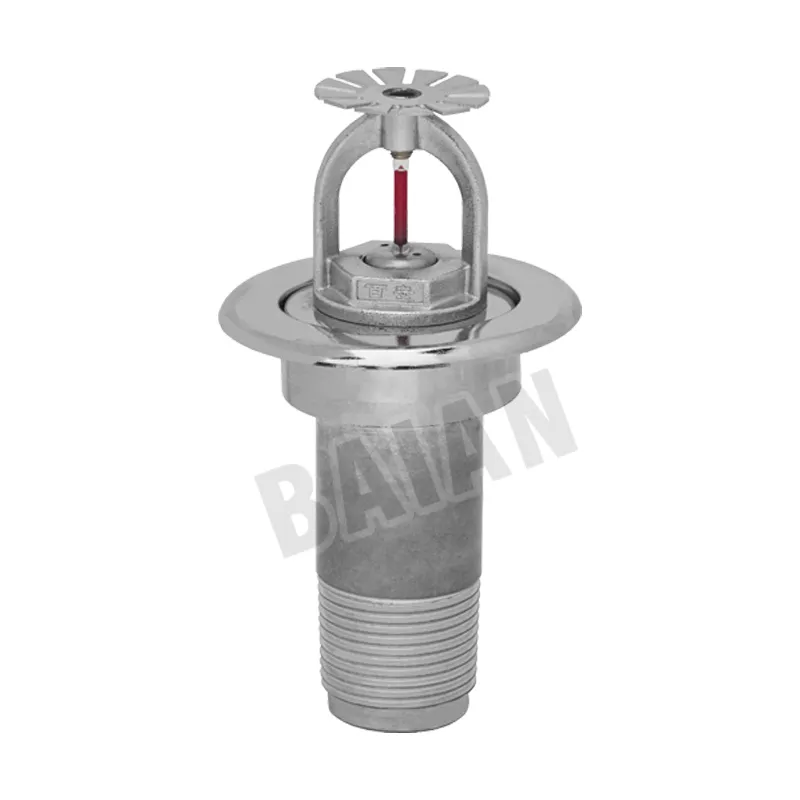
- Among the fire sprinkler family, there is a member specifically designed for extreme environments. It can remain on standby in sub-zero temperatures and above 70 degrees Celsius, ready to extinguish fires at any time.
In environments with temperatures below 4°C or above 70°C, traditional wet sprinklers will fail due to the water in the pipes freezing or vaporizing.
Dry sprinklers solve this problem through a special design: they have a short pipe that remains dry and unfilled in the pre-operation state, thus avoiding the risk of freezing or vaporization.
01 Core Components of Dry Systems
Dry sprinklers are a key component of dry automatic sprinkler systems. Unlike common wet systems, dry systems, in the pre-operation state, are filled with pressurized gas, not water.
Dry sprinklers typically consist of several components, including a sprinkler frame, deflector, heat-sensitive element (glass bulb), nozzle, and seals.
Some dry sprinkler heads can be understood as sprinkler heads with a built-in short pipe, which remains dry when the system is not activated. This unique design allows them to adapt to special environments where wet sprinkler systems cannot function properly.
02 Working Principle and Process
The working principle of a dry sprinkler system is unique. When a fire occurs, the ambient temperature rises, and the heat-sensitive element of the closed sprinkler head activates first.
After the sprinkler head opens, pressurized gas in the pipes is expelled first. As the gas is expelled, the pipe network pressure drops, triggering the dry alarm valve to open. Subsequently, pressurized water from the supply pipe enters the distribution network. Finally, the water flows to the sprinkler head and begins to spray water to extinguish the fire.
Compared to wet sprinkler systems, dry sprinkler systems have an added venting process, resulting in a slightly longer fire extinguishing response time. However, it is precisely this characteristic that allows them to operate reliably in special temperature environments.
03 Unique Advantages and Application Value
The biggest advantage of dry sprinkler heads is that they overcome the temperature limitations of automatic sprinkler systems. It enables the installation of automatic sprinkler systems in low-temperature locations such as cold storage facilities and unheated underground garages, as well as in certain high-temperature industrial areas.
Because the pipes are not filled with water when not in operation, the risk of water damage due to pipe leaks is reduced. In dry-pipe systems or pre-action systems where pendant sprinklers must be installed, specialized dry-piped sprinklers must be used, not ordinary pendant sprinklers.
These sprinklers prevent water from entering the sprinkler head pipe through an internal sealing mechanism, allowing water flow only when the system is activated.
04 Applicable Locations and Regulatory Requirements
Dry sprinkler systems are particularly suitable for buildings and locations where the ambient temperature is below 4°C or above 70°C. Typical applications include unheated underground garages, various types of cold storage facilities, and production areas with high-temperature processes.