


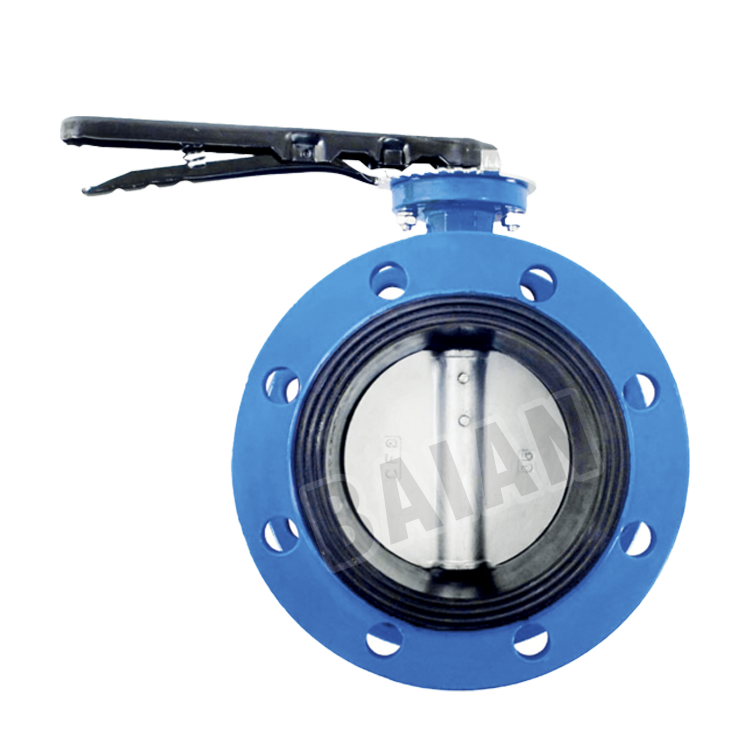
- In the vast network of industrial fluid transportation, control valves act as precise “traffic commanders,” and flanged-handle butterfly valves, with their unique structure and superior performance, have become a widely used key component. They are not only powerful tools for controlling the flow and regulation of pipeline media, but also crucial links in ensuring the safe, efficient, and economical operation of the system.
I. Structural Definition and Working Principle
- As the name suggests, a flanged-handle butterfly valve mainly consists of a flanged valve body, a disc-shaped butterfly plate, a valve stem perpendicularly penetrating the butterfly plate, and an operating handle. Its “flange” design allows the valve to be tightly connected to the pipeline flange via bolts, ensuring convenient installation and reliable sealing. The “butterfly plate,” as the core opening and closing element, rotates through the valve stem.
- Its working principle is intuitive and efficient: when the operator turns the handle clockwise or counterclockwise, the power is transmitted through the valve stem to the butterfly plate, causing it to rotate 90 degrees within the valve body. When the butterfly plate plane is parallel to the pipeline axis, the valve is fully open with minimal flow resistance; when the butterfly plate plane is perpendicular to the pipeline axis, the valve is closed, cutting off the flow of media. Flow rate can be steplessly adjusted by controlling the rotation angle of the handle.
II. Core Advantages and Significant Features
- Easy Operation, Rapid Opening and Closing: The handle requires minimal effort to operate; a 90-degree rotation is sufficient to fully open or close the valve, enabling rapid response to control needs, making it particularly suitable for applications requiring frequent operation.
- Compact Structure, Space Saving: Compared to gate or globe valves of the same diameter, butterfly valves are thinner, smaller, and lighter, significantly saving installation space and material costs.
- Low Flow Resistance, Energy Efficient: When fully open, the butterfly plate offers minimal obstruction to the medium, resulting in low pressure loss and helping to reduce energy consumption in pipeline systems. This makes it particularly suitable for high-flow-rate, low-pressure-differential media such as water, air, and gas.
- Reliable Sealing, Easy Maintenance: Butterfly valves using elastic sealing rings (such as rubber or PTFE) achieve excellent soft sealing, reaching a “zero-leakage” standard. Furthermore, most butterfly valve sealing rings are replaceable, eliminating the need to remove the entire valve from the pipeline for maintenance, reducing maintenance costs and downtime.
- Widely applicable and highly adaptable: From standard temperature and pressure water supply and drainage systems to corrosive chemical media, and even the food and pharmaceutical industries, flanged handle butterfly valves can adapt to diverse operating conditions by selecting different valve body materials (such as cast iron, cast steel, and stainless steel) and sealing materials.
III. Typical Applications and Selection Considerations
- Flanged handle butterfly valves are widely used in municipal water supply, building fire protection, HVAC, industrial cooling water, sewage treatment, power generation, food processing, and many other fields. They are mainly used to cut off or connect pipeline media, or to perform simple flow regulation.
- When selecting valves for your company’s system, pay close attention to the following:
- Nominal diameter and pressure: Ensure the valve size matches the pipeline, and that the nominal pressure (PN) meets the system’s highest operating pressure requirements.
- Media and temperature: Select appropriate valve body materials and sealing materials based on the characteristics of the transported medium (corrosiveness, particulate matter, etc.) and the operating temperature range.
Connection standards: Confirm that the valve’s flange standard (such as GB, HG, ANSI, etc.) is consistent with the pipeline flange to ensure smooth installation and sealing. In conclusion, flanged butterfly valves, with their practicality, economy, and reliability, have become an indispensable cornerstone valve in modern pipeline engineering. Correct selection and use can bring lasting stability and efficiency to your fluid control system.
Exploring superior fluid control solutions? We are always ready to provide you with professional technical support and product services.