


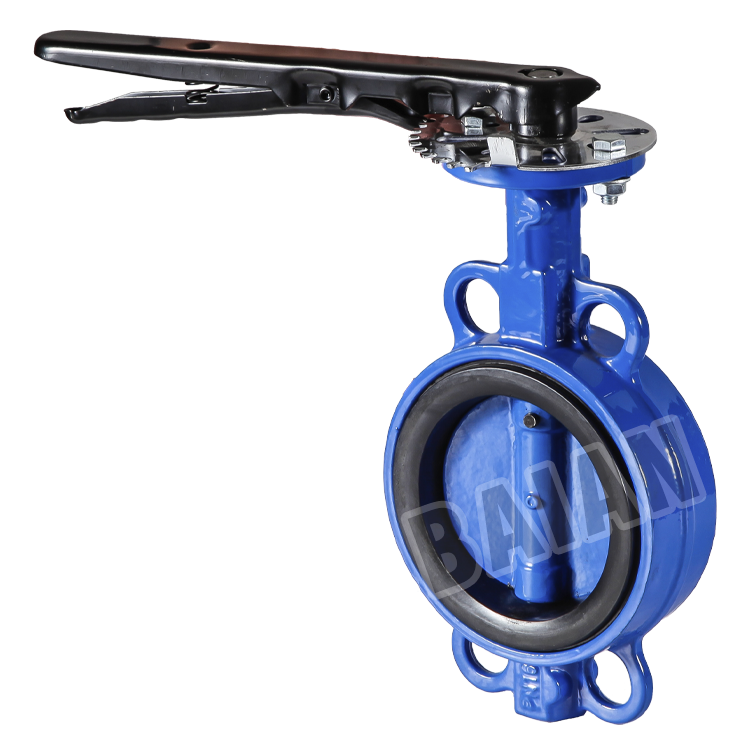
In the vast system of industrial fluid control, the wafer handle butterfly valve, with its unique structure and convenient operation, has become an indispensable key control component in many pipeline systems. It is particularly suitable for applications requiring frequent opening and closing, rapid shut-off, or fluid regulation, and is a classic example of a flexible combination of automation and manual control.
I. Product Definition and Structural Overview
As the name suggests, the wafer handle butterfly valve features a wafer-type connection, meaning the valve itself has no flange; instead, it is directly clamped between two flanges on the pipeline using long bolts. This design makes its structure extremely compact and lightweight. Its core components mainly include:
- Valve Body: Streamlined channel, low fluid resistance.
- Butterfly Plate: A disc-shaped opening and closing element that can rotate around the center of the valve stem.
- Valve Stem: Connects the handle and the butterfly plate, transmitting torque.
- Sealing Ring: Typically made of rubber or polymer material, ensuring a tight seal when closed.
- Handle (Operating Mechanism): Provides manual operation; rotating 90 degrees fully opens or closes the valve, with clear and intuitive position indication.
II. Working Principle
Its working principle is simple and efficient. When the handle rotates, it drives the valve stem and butterfly plate to rotate synchronously.
Open State: The butterfly plate rotates to be parallel to the fluid flow direction, the valve is fully open, flow resistance is minimal, and the medium flows smoothly.
Closed State: The butterfly plate rotates to be perpendicular to the pipeline axis, and its circumferential edge presses against the valve seat sealing ring, forming an elastic seal, thereby cutting off the medium.
III. Core Advantages and Features
- Compact Structure, Economical and Efficient: The clip-on design saves materials, is small in size and light in weight, not only reducing its own cost but also reducing the requirements for pipeline support structures, making installation more convenient.
- Rapid Opening and Closing, Easy Operation: Only a 90° rotation of the handle is needed to quickly complete the opening and closing action, saving time and effort, making it ideal for applications requiring rapid response.
- Low flow resistance coefficient, energy saving: When fully open, the butterfly plate causes minimal obstruction to the medium, effectively reducing pressure loss in the pipeline system and achieving energy-saving operation.
- Easy maintenance, long service life: Simple structure, few parts, and minimal daily maintenance workload. Most designs allow for online replacement of the valve seat seal ring, significantly reducing maintenance costs and downtime.
- Good shut-off and regulation performance: Reliable sealing performance under low or medium pressure conditions. Linear flow regulation can be achieved by changing the opening angle of the butterfly plate.
IV. Main Application Areas
Due to its excellent performance, the wafer-handle butterfly valve is widely used in:
- Water supply and drainage systems: Urban water supply, sewage treatment, building pipe networks.
- HVAC: Cooling water and chilled water circulation systems.
- Fire protection systems: As a zone control valve.
- Food and pharmaceutical industries: Suitable for media with high purity or hygiene requirements.
- General industrial pipelines: Transporting water, air, oil, and other mild corrosive media.
In summary, the wafer-style butterfly valve is a practical valve that combines lightweight design, quick operation, excellent sealing, and high cost-effectiveness. It serves as a reliable “switch” in piping systems and is a key component in achieving efficient process control. Properly selecting a high-quality wafer-style butterfly valve can bring long-term stable operation and significant economic benefits to your system.