




 PT
PT  EN
EN  FR
FR  ES
ES  RU
RU  FA
FA 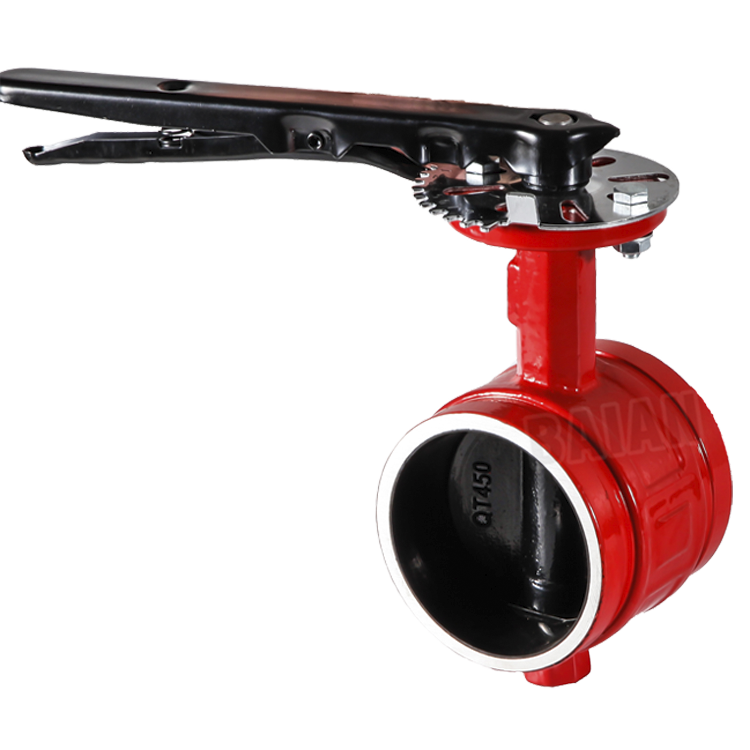
- Opening and closing with a simple 90-degree rotation, this simple yet crucial component supports a vast network ranging from urban water supply to industrial systems, revolutionizing pipeline connections with its superior sealing and ease of use.
Core Definition: What is a Grooved Handle Butterfly Valve?
- A grooved handle butterfly valve is an industrial valve using a grooved clamp connection. Rotating the handle drives a disc-shaped butterfly plate within the valve body to rotate 90°, achieving rapid shut-off or regulation of pipeline media flow.
- The valve body is typically made of robust ductile iron with epoxy resin coating for corrosion protection. The butterfly plate features an integral rubber-coated design, ensuring excellent sealing and durability.
- Compared to traditional flange connections, grooved connections eliminate the need for welding and secondary galvanizing; clamping is all that’s needed, greatly simplifying the installation process.
Key Advantages: Why is it the Industry’s Preferred Choice?
- The core competitiveness of this valve lies in its comprehensive performance. It features bidirectional sealing capability, ensuring reliable sealing regardless of the direction of medium flow, eliminating the need to consider flow direction during installation.
- Its unique grooved design enables quick, easy, and reliable installation, unrestricted by installation site limitations, and effectively overcomes the effects of pipe misalignment and thermal expansion and contraction.
- In operation, it boasts a compact structure, lightweight design, low operating torque, and extremely smooth opening and closing. Its streamlined butterfly plate design results in a low flow resistance coefficient, high flow capacity, and significant energy savings.
Key Applications: Which Fields Can’t Do Without It?
- Grooved handle butterfly valves have an extremely wide range of applications and are standard equipment in many critical infrastructure and industrial systems.
- In fire protection and water supply systems, it is a core control component, and its reliable sealing is crucial for system safety.
- In the HVAC field, it is used to control the on/off and flow regulation of chilled, hot, and cooling water, ensuring efficient system operation.
- Furthermore, it is widely used as a reliable shut-off or regulating device in fluid transport pipelines in industries such as petrochemicals, pharmaceuticals, food processing, and municipal engineering.
Professional Selection: How to Ensure Optimal Performance?
- Selecting the right grooved butterfly valve requires considering several factors. First and foremost is choosing the appropriate valve body material and sealing material based on the characteristics of the medium (e.g., corrosiveness, presence of particulate matter), such as nitrile rubber, ethylene propylene rubber, or fluororubber, to adapt to different temperature and chemical environments.
- Secondly, the working pressure and nominal diameter (commonly DN50-DN300) must be clearly defined to ensure the valve performance matches the system requirements.
- For applications requiring remote monitoring (such as fire protection systems), models with signal feedback devices can be selected. The valve’s opening and closing status can be converted into an electrical signal output, enabling intelligent system monitoring.
When fully open, the thickness of the grooved handle butterfly valve’s disc is the only major resistance to the medium flowing through the valve body. This ingenious design results in minimal pressure drop, giving it excellent flow control characteristics. From water plants to chemical plants, from fire pipes in skyscrapers to cooling systems in workshops, this valve silently and reliably maintains the unseen fluid lifeline of modern society.