





 PT
PT  EN
EN  FR
FR  ES
ES  RU
RU  FA
FA Basic definition
- The foam open system (also known as foam water deluge system) is a foam water sprinkler system that uses open sprinklers. The sprinklers are usually open, and the automatic fire detection system linkage controls the opening of the deluge valve to spray foam mixture all over the area at the same time. The system has both foam fire extinguishing and automatic water spray cooling functions. It belongs to the “overall response” fire extinguishing system, which can quickly cover the entire protection area at the beginning of a fire.
Core components
- Open nozzle: no thermal sensor, usually open, divided into standard type and foam special type, used for rapid injection of foam mixing
liquid - Deluge valve group: the core control component of the system, which is opened after receiving the fire signal, and simultaneously delivers foam mixture and water to the protection area
- foam liquid supply device: including foam liquid storage tank, capsule and pressure type proportioner to ensure that foam liquid and water are mixed at the ratio of 3% or 6%
- Fire pump set: provide the pressure water source required by the system, including fire pump and foam liquid pump
- Fire detection and control system: including fire detectors (smoke/temperature sensing), linkage controllers, manual control panels, to achieve automatic/manual system startup
- Pipeline system: open pipe network is adopted without water flow indicator to ensure that foam mixture can reach all nozzles quickly
Princípio de funcionamento
- Fire detection: When a fire occurs, the fire detectors in the protected area send alarm signals to the controller
- Linkage start: The controller activates the rain shower valve, fire pump, and proportional mixer solenoid valve in a coordinated manner, allowing pressure water to enter the system pipeline
- foam mixing: when pressure water passes through the proportioner, it is mixed with foam liquid according to the preset proportion to form foam liquid mixture
- Whole area spraying: foam mixture is sprayed to the fire area through all open nozzles at the same time, and the fire is extinguished by the effects of sealing, cooling and suffocation
- Automatic switching cooling: after the foam injection reaches the specified time (usually 10-15 minutes), the system will automatically switch to the water spray mode to continuously cool the protection zone to prevent re ignition
- System reset: After the fire is extinguished, manually shut down the system, drain the remaining water in the pipeline network, and restore the system to standby mode
Core strengths
- Extremely fast response speed and strong fire control capability
- The open nozzle can spray without waiting for the temperature to rise, and the fire detection system can cover the entire protection area within 10 seconds after sending a signal
- Simultaneous spraying across the entire area can quickly control large-scale fires and flowing fires, preventing the spread of fire
- Dual fire extinguishing efficiency, strong ability to prevent reignition
- First spray foam to extinguish the fire, then automatically switch to spray water for cooling, effectively preventing the re ignition of flammable liquid caused by high-temperature objects
- Foam cover can isolate oxygen, spray cooling can reduce ambient temperature, and double guarantee fire extinguishing effect
- Wide applicability and strong scene compatibility
- Suitable for large open spaces (such as aircraft hangars, large oil tank areas) and places with fast fire spread
- Suitable foam liquid (aqueous film-forming, fluoroprotein, solubility resistance, etc.) and nozzle type can be selected according to different protection objects
- High system reliability and easy maintenance
- Open nozzles have no heat-sensitive elements, preventing false activation due to dust, corrosion, or temperature fluctuations
- System components are highly standardized; routine maintenance mainly includes foam liquid replacement and pipeline pressure checks
- Flexible design and strong customizability
- Multiple deluge valve groups can be set according to the size of the protected area for zoned protection
- Can be combined with mobile foam monitors and foam guns to enhance the system’s firefighting capability
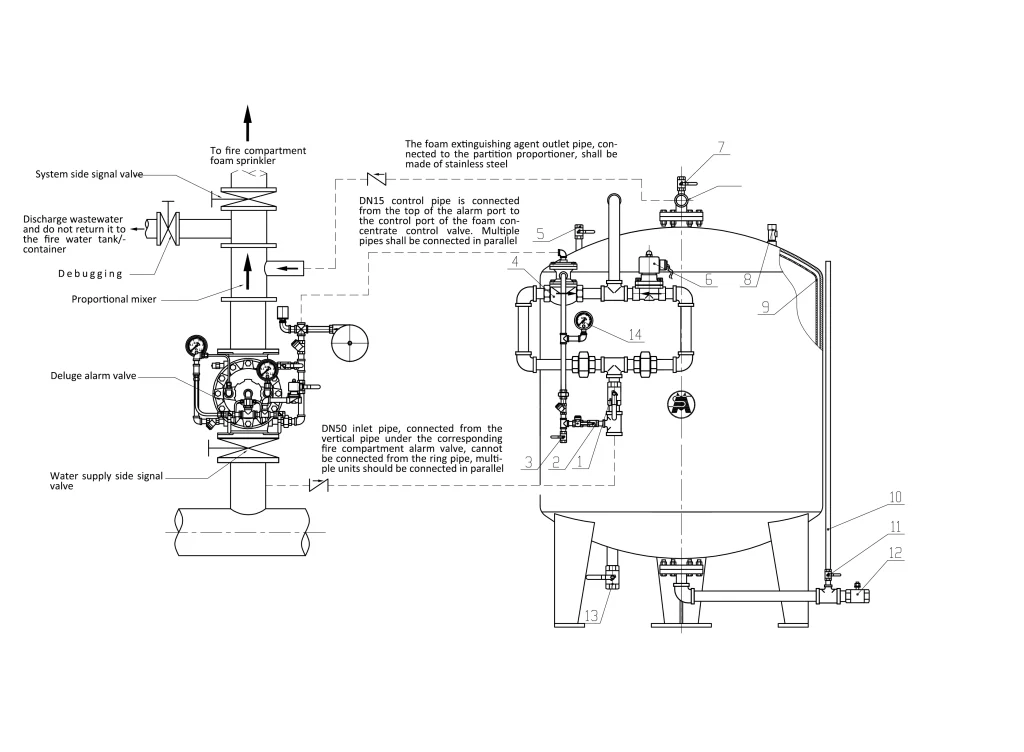
| No | Nome |
| 1 | Main water inlet control valve (normally open) |
| 2 | Control chamber water inlet valve (normally open) |
| 3 | Emergency start valve (normally closed) |
| 4 | Foam liquid control valve (hydraulically operated) |
| 5 | Tank vent valve (normally closed) |
| 6 | Solenoid valve DC24v |
| 7 | Capsule vent valve (normally closed) |
| 8 | Safety valve |
| 9 | Foam liquid capsule |
| 10 | Liquid level gauge |
| 11 | Liquid level gauge valve (normally closed) |
| 12 | Capsule filling/draining valve (normally closed) |
| 13 | Tank drain valve (normally closed) |
| 14 | Control chamber pressure gauge |
Filling of foam extinguishing agent
- Open the tank exhaust valve (5) and capsule exhaust valve (7), and close the tank drain valve (13).
- First fill the tank with clean water of about 10%~20% of the tank capacity to prevent the capsule (9) from being pulled off when filling foam extinguishing agent, which can be injected from the tank exhaust valve (5) or tank drain valve (13). If the system has been supplied with water, it can also directly open the emergency start valve (3) to inject water into the tank.
- Open the level gauge valve (11), open the capsule filling/discharging valve (12), connect the outlet of the filling pump with it, start the filling pump to inject foam extinguishing agent into the capsule (9), and it is recommended to use a plastic chemical pump for the filling pump.
- When filling, always observe the liquid level gauge (10). When the filling amount reaches about 50%, open the tank drain valve (13) to drain all the water in the tank. After filling is completed, close the tank drain valve (13), capsule filling/discharging valve (12), and liquid level gauge valve (11). At the same time, close the top tank exhaust valve (5) and capsule exhaust valve (7) to complete the filling.
Debug
- Close the main inlet control valve (1), open the inlet valve (2) of the control chamber, put the pressure water into the control chamber of the foam concentrate control valve (4), and observe that when the pressure gauge (14) of the control chamber rises to the same pressure as the water supply, the foam concentrate control valve (4) automatically closes, open the main inlet control valve (1), reset it, and the device is in the fire fighting ready state.
- Close the signal valve on the system side, open the signal valve on the water supply side, reset the deluge valve group, open the commissioning valve, and manually start the deluge valve group. At this time, the fire water enters the system, and part of the alarm water enters the alarm pipeline to drive the hydraulic alarm bell and pressure switch, and at the same time enters the valve chamber of the foam concentrate control valve to drive the foam concentrate control valve to open, and the fire water enters the foam tank from the foam concentrate control valve to squeeze the capsule (9), so that the foam extinguishing agent flows out into the foam proportioner to mix with the fire water. At this time, observe the outlet of the commissioning valve, and the outflow water turns into the mixed liquid with foam. After the commissioning is completed, reset the deluge valve, reset the foam concentrate control valve, and Debug the valve, open the signal valve on the system side, and the commissioning is completed. 3. The solenoid valve (6) is a normally closed type, connected to the DC24V port of the fire output module, and controlled by the fire alarm control host for opening and closing.